
Confined Space Rescue Cover Explained: UK Legal Requirements and Best Practice

Confined space work carries a simple legal reality: if someone enters, there must be a way to get them out safely in an emergency. That rescue arrangement cannot be an afterthought, and it cannot rely on hope, good luck, or a vague plan to call 999.
For health and safety managers, site managers, contractors and project teams, this raises an important question. What does the law actually require when it comes to confined space rescue cover?
The answer is clear, but often misunderstood. UK legislation requires suitable and sufficient emergency arrangements before confined space entry takes place. It does not automatically require a dedicated external rescue team for every confined space job.
This article explains the key legal duties under the Confined Spaces Regulations 1997, with particular focus on Regulation 5 and HSE guidance L101. It also looks at when a specialist confined space rescue team may be needed, what a suitable rescue plan should include, and how INFRATEC Rescue & Safety supports higher-risk confined space operations across the UK.
This article is general information only and should not be treated as legal advice. Duty holders should assess each confined space activity on its own risks and seek competent advice where needed.

What UK law says about confined space rescue arrangements
The main legislation is the Confined Spaces Regulations 1997. These regulations apply where work takes place in a confined space and there is a reasonably foreseeable specified risk.
A confined space may include tanks, vessels, pits, sewers, silos, chambers, ducts, voids, shafts, culverts and similar enclosed or partially enclosed areas. The key issue is not only the shape of the space. It is whether the conditions create one or more specified risks, such as:
Serious injury from fire or explosion
Loss of consciousness from heat
Loss of consciousness or asphyxiation from gas, fumes, vapour or lack of oxygen
Drowning from rising liquids
Asphyxiation from free-flowing solids
The regulations require employers and those in control of work to avoid entry where reasonably practicable. If the work can be completed from outside the space, that route should be considered first.
Where entry cannot be avoided, the work must be properly planned, risk assessed and controlled. That includes emergency arrangements.
Regulation 5 requires a suitable rescue plan before entry
Regulation 5 of the Confined Spaces Regulations 1997 is central to confined space rescue requirements UK duty holders need to understand.
In practical terms, Regulation 5 means no person should enter or work in a confined space unless there are suitable and sufficient arrangements for rescue in an emergency. Those arrangements must be in place before entry starts.
This is not just a paperwork duty. The rescue arrangements must work in the real conditions of the job.
HSE’s Approved Code of Practice and guidance, commonly referred to as L101, gives further detail on what this means. It makes clear that emergency arrangements should be proportionate to the risk and should cover rescue, resuscitation where needed, communication, equipment, trained personnel and ways to raise the alarm.
A permit-to-work system, risk assessment and method statement may all refer to rescue arrangements. That is useful, but a written line in a document is not enough. The question is whether the people, equipment and procedures can deliver a safe rescue quickly enough if something goes wrong.
Does the law require a dedicated confined space rescue team?
Not in every case.
UK law requires suitable emergency rescue arrangements. It does not say that every confined space entry must have a dedicated external confined space rescue team on standby.
For lower-risk confined space work, an employer may be able to provide suitable arrangements using trained in-house personnel, appropriate equipment and a rehearsed emergency plan. For example, some entries may be simple, shallow, well-ventilated and controlled, with low foreseeable risk and a reliable non-entry rescue method.
For higher-risk work, a dedicated rescue provision may be necessary. This could be provided by an internal team, a specialist contractor, or a combination of both, depending on the site, task and risk assessment.
The legal test is not whether a rescue team has been hired. The legal test is whether the arrangements are suitable and sufficient for the foreseeable emergency.
That means duty holders need to consider:
The nature and size of the confined space
The hazards inside and around it
How quickly a casualty may need to be rescued
Whether non-entry rescue is possible
The competence of available personnel
The equipment needed for access, rescue and recovery
Communication between entrants, attendants and rescue personnel
Site access for emergency support
The effect of simultaneous operations nearby
A rescue plan that is suitable for one task may be completely unsuitable for another.
Why calling the emergency services is not an adequate rescue plan on its own
One of the most common mistakes in confined space planning is stating that the emergency procedure is simply to call the fire and rescue service.
Emergency services play a vital role, but relying solely on them is not usually a suitable confined space rescue plan. There are several reasons for this.
Response times can vary. The nearest crew may not be immediately available, and the first responders may not have the specialist confined space equipment or site knowledge needed for the specific task.
The rescue may also need to begin within minutes. In an oxygen-deficient atmosphere, toxic environment, heat-stress event or engulfment scenario, delay can have serious consequences.
Emergency responders may need information before they can act safely, including:
Layout of the confined space
Access and egress points
Atmospheric hazards
Isolation status
Substances present
Structural restrictions
Casualty location
Rescue equipment already available on site
They may also need to carry out their own dynamic risk assessment before entry. That takes time.
HSE guidance expects employers and duty holders to make effective arrangements themselves. The emergency services may form part of escalation, but they should not be treated as the only rescue measure unless the risk assessment genuinely supports that approach.
What a suitable confined space rescue plan should include
A good rescue plan is practical, task-specific and understood by everyone involved. It should match the hazards of the confined space and the likely emergency scenarios.
A suitable plan will normally include the following elements.
Clear roles and responsibilities
Everyone involved should know what they are expected to do in an emergency. This includes entrants, top-watch or attendants, supervisors, rescue personnel and site management.
The plan should identify who raises the alarm, who controls the area, who communicates with rescue personnel, and who liaises with the emergency services if they are called.
Communication arrangements
There must be a reliable way to communicate between those inside the confined space and those outside it.
This may include radios, hard-wired communication systems, agreed signals, visual contact, gas monitor alarms, or a combination of methods. The system must work in the actual environment, including noise, distance, steel structures, underground areas and poor visibility.
Rescue method
The plan should explain how a casualty will be recovered.
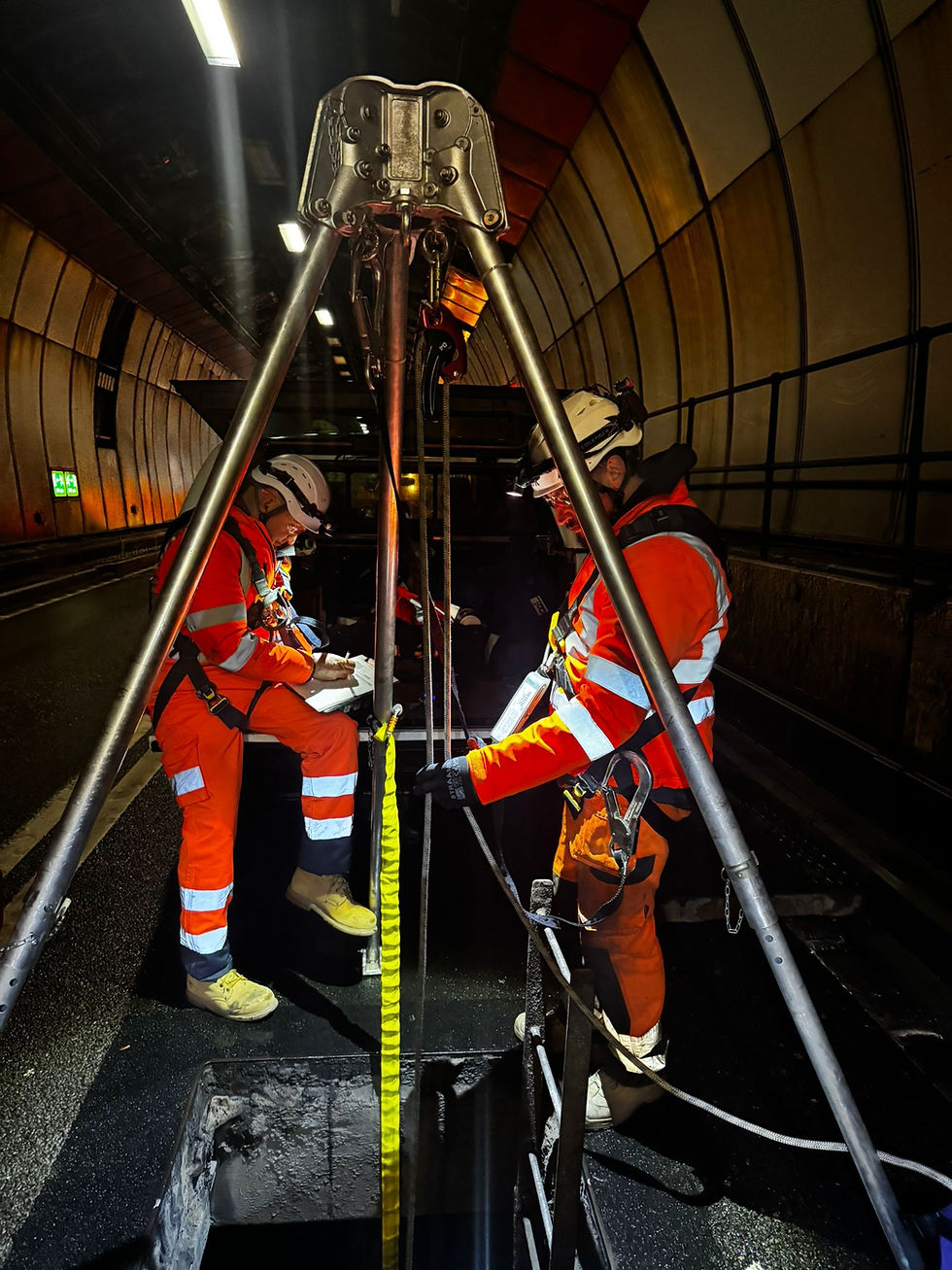
Where possible, non-entry rescue is preferred because it reduces risk to rescuers. This may involve harnesses, lifelines, retrieval systems, tripods, davits or winches.
In some cases, non-entry rescue may not be possible. The route may involve bends, vertical descents, internal obstructions, long travel distances, ladders or multiple levels. If entry rescue could be needed, the plan must account for the added risk to rescuers.
Competent rescue personnel
Rescue personnel must be trained, competent and physically capable of carrying out the rescue method. Competence is not limited to holding a certificate. It includes knowledge, skill, experience and familiarity with the equipment and environment.
Personnel may need competence in:
Confined space entry and rescue
Use of breathing apparatus
Casualty handling
Rope access or technical rescue methods
Gas monitoring
Emergency first aid
Resuscitation equipment
Incident communication and control
Suitable rescue and emergency equipment
The equipment must be suitable for the space and the foreseeable incident. It should be inspected, maintained and ready for use.
Depending on the work, equipment may include:
Gas detection equipment
Escape breathing apparatus
Working and rescue breathing apparatus
Harnesses and lifelines
Tripods, davits and recovery winches
Stretchers and casualty packaging systems
Lighting
Radios or other communication systems
First aid and resuscitation equipment
Barriers and access control equipment
Equipment must also be compatible. A harness, winch and stretcher arrangement that works in training may not work through a narrow hatch or around internal pipework.
Rehearsal and emergency preparedness
A rescue plan should not exist only in a site file. Teams need to understand it before work starts.
For higher-risk work, drills or scenario walkthroughs can reveal problems early. These might include poor radio reception, unsuitable access points, missing equipment, unclear handover arrangements or unrealistic rescue timings.
Pre-start briefings are also essential. Contractors, client teams and rescue personnel should share the same understanding of the task, hazards and emergency actions.
When specialist rescue teams may be necessary
A specialist rescue team may be needed when the foreseeable risks or practical rescue challenges exceed what the site can safely manage in-house.
This is common during:
Industrial shutdowns and turnarounds
Maintenance outages
Energy-from-waste facility work
Tank cleaning and inspection
Vessel entry
Silo and hopper work
Sewer, culvert and chamber access
Construction projects with shafts, excavations or service voids
Work involving inert atmospheres, fumes, residues or restricted access
Multi-contractor projects with changing site conditions
Specialist confined space rescue cover may also be appropriate where the rescue demands breathing apparatus, technical lifting systems, rope rescue, complex casualty extraction or continuous standby arrangements.
The decision should be based on risk assessment. A dedicated team may not be legally required for every entry, but where the risk warrants it, failing to provide one could leave the duty holder unable to demonstrate suitable emergency arrangements.
Best practice for managing confined space rescue cover
Good practice starts early. Rescue should be planned at the same time as the work, not added after the method statement has already been agreed.
The following approach helps keep planning clear and defensible.
Planning stage | What to check |
Before work is approved | Can entry be avoided, and have alternatives been considered? |
During risk assessment | What are the specified risks and likely emergency scenarios? |
During method planning | Can rescue be achieved without entry? |
Before mobilisation | Are competent people and suitable equipment available? |
Before entry | Has the team been briefed and communication tested? |
During the task | Are conditions monitored and emergency arrangements maintained? |
After completion | Were any lessons identified for future work? |
This approach also helps avoid a common problem. A rescue plan may look suitable at tender or planning stage, but later changes can make it invalid. Examples include a different access point, additional pipework, changes to isolation, extra contractors, altered ventilation or a change in the substance present.
Rescue arrangements should be reviewed when the job changes.
How INFRATEC Rescue & Safety supports confined space operations
INFRATEC Rescue & Safety provides specialist support for confined space operations across the UK, including industrial shutdowns, maintenance outages, energy-from-waste facilities, construction projects and other high-risk work environments.
The role of a specialist provider is to help clients put practical, risk-based arrangements in place. That can include standby rescue teams, rescue planning input, equipment provision, breathing apparatus capability, site-specific briefings and support for complex access or recovery scenarios.
The aim is not to add unnecessary resource to every confined space entry. The aim is to help duty holders make the right decision for the risk.
For some tasks, that may mean confirming that a trained in-house team and non-entry rescue equipment are suitable. For more complex or hazardous work, it may mean providing a dedicated rescue presence with the competence and equipment needed to respond quickly.
This balanced approach matters because confined space rescue cover should be proportionate, practical and legally defensible.

The key takeaway for duty holders
The law is clear on the outcome required. Before anyone enters a confined space, suitable and sufficient rescue arrangements must be in place.
That does not mean every confined space job requires a dedicated external team. It does mean the rescue plan must be realistic, properly resourced and matched to the hazards of the work.
Relying only on the emergency services is unlikely to be enough for many confined space activities. A suitable plan should cover communication, competent people, equipment, rescue methods, casualty recovery, escalation and emergency preparedness.
Where the work involves higher risk, complex access, breathing apparatus, technical recovery or time-critical rescue, a specialist confined space rescue team may be the safest and most appropriate option.
If you are planning confined space work, shutdown activity, an outage or a construction project involving restricted access, contact INFRATEC Rescue & Safety to discuss your rescue cover requirements and the level of support your operation may need.
Comments